Water Quality Report: How to Find and Read Yours
How to find your drinking water quality report (CCR), read the contaminants table, and what to do if something looks wrong.

How to test your water, read your water report, and understand the most common problems in US homes, from hard water to chlorine, iron and well water.
New to water treatment? Read these first.
What causes it, how hard is too hard, and how it affects your home.
Five easy methods, from test strips to a certified lab.
Map and data for all 50 states and major US cities.
Look up the hardness for your ZIP code or city in seconds.
Good TDS levels, testing and how to lower it.
Glass, faucets, sinks and toilets, step by step.
Make sense of your city’s annual Consumer Confidence Report.
What to test for, how often, and where to send samples.
Match what you see at home to the likely cause and the usual fix.

White scale, spotty dishes, poor lather, dry skin. Caused by calcium and magnesium.
Fix: water softener →
Pool-like smell in city water. Utilities add chlorine to keep water safe from germs.
Fix: carbon filter →
Orange or brown stains in sinks, toilets and laundry. Common in well water.
Fix: iron filter or softener
Worried about lead, nitrate or PFAS? You can’t see, taste or smell most of them.
Fix: certified lab test first| What you notice | Likely cause | Usual fix |
|---|---|---|
| White crust on faucets, spots on glass | Hardness (calcium, magnesium) | Water softener |
| Swimming-pool smell or taste | Chlorine or chloramine | Carbon filter |
| Orange or brown stains | Iron | Iron filter or softener |
| Black stains or specks | Manganese | Manganese or oxidizing filter |
| Rotten-egg smell | Hydrogen sulfide | Oxidizing or carbon filter |
| Cloudy water that clears from the bottom up | Tiny air bubbles (usually harmless) | None needed |
| Blue-green stains | Corrosive water reacting with copper pipes | Test pH; neutralizer |
Iron starts to stain at about 0.3 mg/L and manganese at about 0.05 mg/L, the EPA’s secondary (non-health) guidelines.
Where your water comes from changes who tests it and what to watch for.
 City water
 Private well
Most US community water systems must send customers an annual Consumer Confidence Report (CCR). It lists what was found in your water and how it compares with EPA limits.
Want an exact number for your own tap? Use a home hardness test.
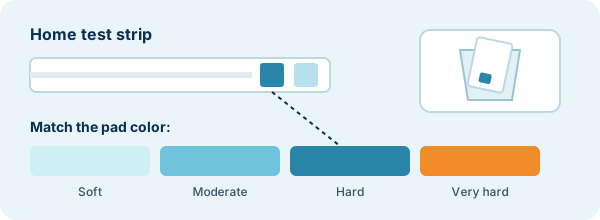
If you are on city water, read your utility’s annual Consumer Confidence Report, which shows test results against EPA limits. If you have a private well, the only way to know is to test it, ideally once a year with a certified lab.
Hard water is not a health risk, so it is treated as an aesthetic issue. It causes scale, spots and dry skin, but the EPA sets no health limit for hardness.
Some problems, like iron, chlorine and sulfur, are easy to notice. Others, such as lead, nitrate and PFAS, have no color, taste or smell, so only a test can find them.
Boiling kills germs, which is why it is used during boil-water notices. It does not remove lead, nitrate or other chemicals, and it can concentrate them as water evaporates.
Tell us what you are seeing at home and we may cover it in an upcoming guide.

How to find your drinking water quality report (CCR), read the contaminants table, and what to do if something looks wrong.
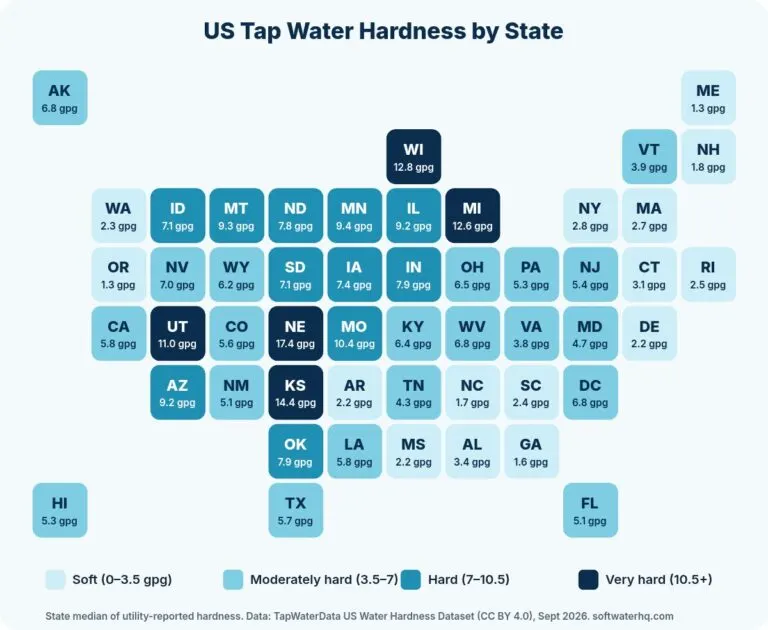
See water hardness for all 50 states on a color-coded map, the hardest and softest states, and real data for major US cities.
Learn how to test water hardness at home with test strips, a drop test kit, your utility report, the soap bottle test or a lab, and how to read your results in GPG.

Hard water is water high in dissolved calcium and magnesium. Learn what causes it, what is considered hard water, the signs to look for, whether it is safe, and how to fix it.