Water Softener Regeneration Cycle: How It Works and How Often
The four stages of a water softener regeneration cycle, how long it takes, how often it should run and how to fix regeneration problems.

How softeners work, which type fits your home, what size you need, and how to tell if you need one at all. Plain English, no sales pitch.

Most home softeners use a process called ion exchange. It happens in three simple steps.
Water carrying dissolved calcium and magnesium enters a tank filled with small resin beads.
The resin beads grab calcium and magnesium and release sodium (or potassium) in their place. Soft water flows to your taps.
When the beads fill up, the softener flushes them with salty brine from the brine tank, rinses the minerals down the drain, and starts again.

Not every system that is sold as a "softener" actually removes hardness. Here is what each type really does.
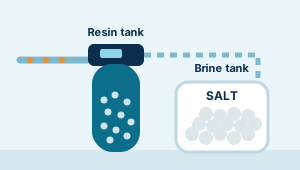 Most common
Removes calcium and magnesium for true soft water. Needs salt refills and a drain line. Best for hard and very hard water.
 Low maintenance
Usually uses TAC media to change minerals so they are less likely to form scale. Does not remove them, so you won't get the soap and skin benefits of soft water.
 Big households
Two resin tanks take turns, so you always have soft water, even while one tank regenerates. Useful for large families or very high water use.
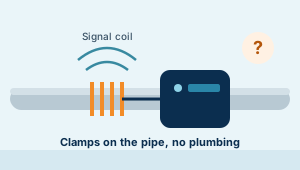 Limited evidence
Clamp-on devices that claim to reduce scale using magnets or electric signals. Independent evidence is mixed, so we treat these claims with caution.
If you notice two or more of these signs, it is worth testing your water hardness.


Test before you buy: use a home test strip or check your water utility's annual Consumer Confidence Report.
| Classification | mg/L (ppm) | Grains per gallon |
|---|---|---|
| Soft | 0 – 60 | 0 – 3.5 |
| Moderately hard | 61 – 120 | 3.5 – 7 |
| Hard | 121 – 180 | 7 – 10.5 |
| Very hard | Over 180 | Over 10.5 |
Classification based on the U.S. Geological Survey (USGS). 1 grain per gallon = 17.1 mg/L.
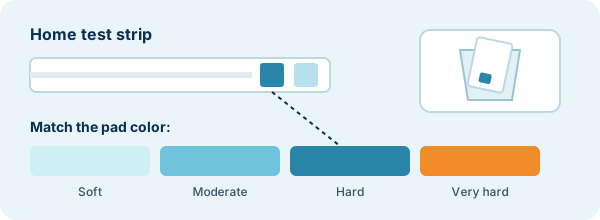
Softeners are rated in grains: how much hardness they can remove before they need to regenerate. A simple way to estimate your daily need:
Have iron in your water too? Add about 3 to 5 GPG for every 1 ppm of iron, and always check the manufacturer's sizing guide.

The biggest decision most homeowners face.
| Salt-Based Softener | Salt-Free Conditioner | |
|---|---|---|
| Removes hardness minerals | Yes | No (reduces scale only) |
| Better soap lather & softer skin | Yes | Little to no change |
| Ongoing cost | Salt refills, some water for regeneration | Media replacement every few years |
| Drain line & electricity | Usually needed | Usually not needed |
| Adds sodium to water | A small amount | No |
| Best for | Hard to very hard water | Moderate hardness, low maintenance |
Some cities and counties restrict salt-based softeners because of the salty discharge. Check your local rules before buying.
In-depth, step-by-step guides for every stage, from testing your water to keeping your softener running.
What causes it, how it affects your home, and when it matters.
Test strips, kits and your utility report, step by step.
Troubleshooting guide for hard water, salt and brine tank issues.
Push-button, knob and three-valve bypass, step by step.
Pellets vs crystals, how much salt and common salt problems.
The key differences for your home, skin and health.
How saltless systems work, what the research says, and who should buy one.
The real difference, and which one fits your water.
Upfront price, installation and yearly running costs.
What DIY install involves and when to call a plumber.
Salt, resin and cleaning tips to keep it running for years.
A well-maintained salt-based softener often lasts 10 to 15 years or more. The resin may need replacing sooner if your water has chlorine or iron. Keeping the brine tank clean and using good-quality salt helps it last longer.
For most healthy people, yes. Salt-based softeners add a small amount of sodium, rising with how hard your water was. If you are on a low-sodium diet, talk to your doctor, use potassium chloride, or drink from a reverse osmosis tap.
No. A softener removes hardness minerals and can remove small amounts of iron, but it is not a filter. To remove chlorine, lead or other contaminants, you need a filtration system certified for those contaminants, such as an NSF-certified filter.
It depends on your water hardness, how much water you use, and the softener's capacity. Many homes regenerate every few days to once a week. Metered softeners regenerate only when needed, which saves salt and water.
Send us your question and we may answer it in an upcoming guide.

The four stages of a water softener regeneration cycle, how long it takes, how often it should run and how to fix regeneration problems.

How a water softener removes hardness through ion exchange, the parts inside it, how regeneration works and what it can and cannot remove.

How to choose and size a water softener for well water, including iron-compensated hardness, pump flow and pre-filters.

How to remove hard water stains from glass shower doors, faucets, sinks, toilets and dishes, plus how to stop them coming back.

Which water softener salt to buy: pellets vs crystals, rock salt, potassium chloride, how much salt to use and how to avoid salt problems.

Hard water vs soft water compared: minerals, effects on your home, skin, hair and health, and how to tell which one you have.
How to bypass a water softener with push-button, knob and three-valve bypass setups, and how to switch it back safely.

Water softener not working? Fix hard water, salt not going down, too much water in the brine tank and other common problems.
How salt-free water softeners work, what the research says, pros and cons, costs and whether a saltless system is right for your home.

A step-by-step water softener buying guide: test your water, size it right, pick the type and features that matter, and avoid common mistakes.