

How to Test Water Hardness at Home (5 Easy Methods)
Last updated: November 5, 2026 · Sources: USGS, U.S. EPA
The easiest way to test water hardness at home is with a hardness test strip: dip it in a glass of cold tap water, wait a few seconds, and match the color to the chart. For a more exact number, use a drop test kit. You can also check your water utility’s annual report, try a free soap bottle test, or send a sample to a certified lab if you have a well.
Knowing your exact hardness matters. It tells you whether you need a water softener at all, and if you do, what size to buy. This guide walks through five ways to test, how accurate each one is, and how to read your results.
Quick comparison
- Fastest: test strips (about 1 minute)
- Most accurate at home: drop (titration) test kit
- Free: your utility’s water report or the soap bottle test
- Best for well water: a certified lab test
- Hard water starts at: about 7 grains per gallon (120 mg/L)
Already have results? Enter them in our free water test results checker to compare them with EPA limits.
5 Ways to Test Water Hardness at Home
| Method | Accuracy | Typical cost | Time | Best for |
|---|---|---|---|---|
| Utility water report | Good (city average) | Free | 5 minutes | City water |
| Test strips | Fair (a range) | Low | About 1 minute | Quick checks |
| Drop test kit | High (exact GPG) | Low to moderate | About 5 minutes | Sizing a softener |
| Soap bottle test | Low (yes or no) | Free | 2 minutes | A first clue |
| Certified lab test | Highest | Highest | Days to weeks | Well water |
1. Check your water utility’s report (free)
If you are on city water, your utility must send customers an annual Consumer Confidence Report (CCR), also called a water quality report. Many utilities list hardness in it, in mg/L (ppm) or grains per gallon. You can usually find it on the utility’s website or on your water bill.
If hardness is not listed, call the utility and ask. Keep in mind this is an average for the whole system. The water at your tap can be a little different, so it is worth confirming with a home test.
2. Use water hardness test strips (fastest)
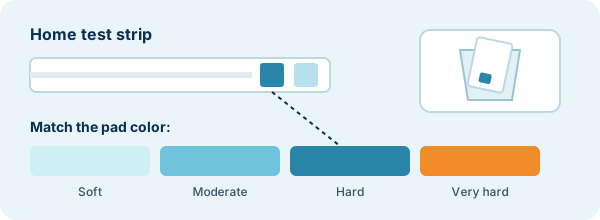
- Run the cold kitchen tap for about 30 seconds.
- Fill a clean glass. Do not use water that has gone through a filter or softener, unless you are checking that system.
- Dip the strip for the time on the package, usually 1 to 2 seconds.
- Wait for the color to develop, then compare it to the chart within the time the instructions give.
- Write down the reading in GPG or ppm.
Strips are cheap and easy, but they show a range, not an exact number. Read them in good daylight, because the colors can look similar.
3. Use a drop test kit (most accurate at home)

A drop test, also called a titration kit, gives you an exact number. This is the best home method if you are about to size a water softener.
- Fill the test tube to the line with cold tap water.
- Add the indicator if your kit uses one. The sample usually turns pink or red when hardness is present.
- Add the reagent one drop at a time, swirling after each drop.
- Stop when the color changes to blue, and count the drops.
- Convert using your kit’s instructions. On many kits, 1 drop = 1 grain per gallon.
4. Try the soap bottle test (free, but rough)

- Fill a clear bottle about one-third full with tap water.
- Add about 10 drops of pure liquid soap, such as castile soap. Avoid detergents, which lather even in hard water.
- Put the lid on and shake hard for 10 seconds.
- Look at the result. Lots of fluffy suds and clear water suggest soft water. Few suds and cloudy, milky water suggest hard water.
This test only tells you whether water is hard, not how hard. Use it as a first clue, then confirm with strips or a drop kit.
5. Send a sample to a certified lab (best for well water)

Private wells are not tested by any utility, so the owner is responsible. A state-certified lab can measure hardness along with iron, manganese, pH, bacteria, nitrates and other contaminants. This matters, because iron in your water changes how you size a softener.
Health agencies advise private well owners to test their water at least once a year. Your state or county health department can point you to certified labs near you.
Does a TDS Meter Measure Hardness?
Not exactly. A TDS meter measures total dissolved solids, which includes calcium and magnesium but also sodium, chloride and other minerals. High TDS can hint at hard water, but it cannot tell you your hardness level. Softened water can even show a high TDS reading, because a softener swaps hardness minerals for sodium. Use a hardness test instead.
How to Read Your Results
Once you have a number, compare it to the generally accepted scale used by the U.S. Geological Survey:
| Result | mg/L (ppm) | Grains per gallon | What it means |
|---|---|---|---|
| Soft | 0 – 60 | 0 – 3.5 | No softener needed |
| Moderately hard | 61 – 120 | 3.5 – 7 | Optional; mild scale possible |
| Hard | 121 – 180 | 7 – 10.5 | A softener is worth considering |
| Very hard | Over 180 | Over 10.5 | A softener is strongly recommended |
Not sure what these levels mean for your home? Read our full guide to what hard water is and how it affects you.
How to convert ppm to grains per gallon
Water softeners are sized in grains per gallon (GPG), but water reports often use mg/L or ppm. Converting is simple:
- GPG = mg/L (or ppm) ÷ 17.1
- mg/L = GPG × 17.1
| mg/L (ppm) | Grains per gallon |
|---|---|
| 50 | 2.9 |
| 100 | 5.8 |
| 150 | 8.8 |
| 200 | 11.7 |
| 250 | 14.6 |
| 300 | 17.5 |
When Should You Test Your Water?

- Before buying a water softener, so you can size it correctly.
- After installing a softener, to check it works. Softened water should test close to 0 to 1 GPG.
- Every few months if you have a softener, to catch problems like a salt bridge early.
- At least once a year if you have a private well.
- When you notice new scale or spots, or after moving to a new home.
Tips for an Accurate Result
- Test cold water. Hot water from a water heater can give a different reading.
- Let the tap run for 30 seconds before you fill your glass.
- Use a clean glass with no soap residue.
- If you already have a softener, test from an outdoor spigot or with the softener on bypass to see your untreated hardness.
- Check the expiry date on strips and reagents. Old ones can give wrong results.
- Test twice and use the higher number when sizing a softener.
What to Do Next
If your water tests above about 7 GPG and you see scale, spots or dry skin, a water softener is usually the best fix. Use your number with the sizing rule in our complete guide to water softeners to find the right capacity for your home.
Frequently Asked Questions
How can I test my water hardness for free?
Check your water utility’s annual Consumer Confidence Report, which often lists hardness, or call the utility and ask. The soap bottle test is also free, but it only shows whether water is hard, not how hard.
Are water hardness test strips accurate?
Test strips are accurate enough to show a hardness range and tell soft from hard water. For an exact grains-per-gallon number, such as when sizing a softener, a drop test kit or lab test is more reliable.
What is a good water hardness level?
Water under about 3.5 grains per gallon (60 mg/L) is considered soft. Softened water usually tests at 0 to 1 GPG. Anything above about 7 GPG is hard enough to cause noticeable scale.
Can I use a TDS meter to test water hardness?
No. A TDS meter measures all dissolved solids, not just calcium and magnesium. It can hint at hard water, but it cannot give your hardness level. Use hardness strips or a drop test kit instead.
How often should I test my water hardness?
Test before buying a softener and again after installing it. If you have a softener, check every few months. Private well owners should test at least once a year.
Sources: USGS: Water hardness in the United States; U.S. EPA Consumer Confidence Report rule.


