What Is Reverse Osmosis Water? How an RO System Works
Last updated: November 6, 2026 · Sources: EPA, EPA WaterSense, NSF
Reverse osmosis (RO) is a water filtration method that pushes water through a very fine membrane that lets water molecules pass but blocks most dissolved minerals, salts and contaminants. A home RO system can remove lead, arsenic, nitrate, fluoride and PFAS, along with most total dissolved solids (TDS). Most homes use a small under-sink RO system that makes drinking water for one faucet.
RO is one of the most thorough ways to clean drinking water at home, but it is not perfect for everyone. It wastes some water, needs regular filter changes and does not soften water for the whole house. This guide explains how it works, what it removes, what it costs and whether it is right for you.
Reverse osmosis at a glance
- What it is: filtration through a semi-permeable membrane under pressure
- Removes: most dissolved solids, lead, arsenic, nitrate, fluoride, PFAS
- Typical setup: under the kitchen sink, with its own faucet
- Cost: about $150 to $1,300 for an under-sink system, installed
- Certification to look for: NSF/ANSI 58
What Is Reverse Osmosis?
Osmosis is a natural process where water moves through a membrane from a weak solution to a stronger one. Reverse osmosis does the opposite. It uses your home’s water pressure to force water through the membrane in the other direction, leaving dissolved minerals and contaminants behind.
The membrane’s pores are so small that they block almost everything except water molecules. The trapped contaminants do not build up on the membrane. Instead, a small stream of water carries them down the drain. This is called reject water or brine.
What Is Reverse Osmosis Water (RO Water)?
Reverse osmosis water, often called RO water, is simply water that has gone through an RO membrane. It is very low in dissolved minerals and contaminants, so it tastes clean and neutral. Many people use it for drinking, cooking, coffee and ice instead of bottled water.
How a Reverse Osmosis System Works
A home RO system is more than just a membrane. Most under-sink systems have four or five stages:
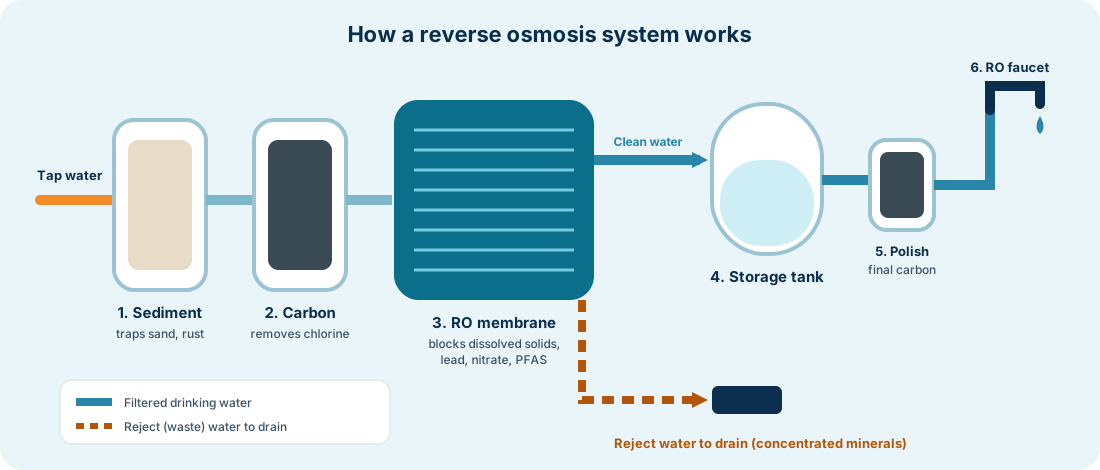
- Sediment filter: catches sand, rust and dirt that could clog the membrane.
- Carbon pre-filter: removes chlorine, which would damage the membrane, plus many taste and odor problems.
- RO membrane: the core stage. It removes most dissolved solids and many health-related contaminants.
- Storage tank: RO is slow, so many systems store a few gallons of filtered water (see our reverse osmosis tank guide). Tankless models use a pump to filter on demand.
- Carbon post-filter: a final “polish” for taste before the water reaches a dedicated faucet on your sink.
What Does Reverse Osmosis Remove?
| Contaminant | Does RO reduce it? | Notes |
|---|---|---|
| Total dissolved solids (TDS) | Yes, most | The main job of the membrane |
| Lead and other heavy metals | Yes | Check the NSF/ANSI 58 listing for each claim |
| Arsenic, nitrate, fluoride | Yes | Common reasons well owners choose RO (see fluoride removal) |
| PFAS (“forever chemicals”) | Yes | The EPA says RO can greatly reduce PFAS |
| Chlorine, taste and odor | Yes, with carbon stages | The carbon filters do this work |
| Hardness (calcium, magnesium) | Yes, at that one tap | It does not soften water for the rest of the home |
| Bacteria and viruses | Not guaranteed | Use a UV system or disinfection for unsafe well water |
Every RO system is different, so always check what a specific model is certified to reduce. Not sure what is in your water? Start with our guide to testing your water at home or read your utility’s water quality report.
Types of Reverse Osmosis Systems
- Under-sink RO with a tank: the most common setup. It is affordable and sits in the cabinet below your kitchen sink.
- Tankless RO: uses an electric pump to filter water on demand. It is more compact and often wastes less water, but costs more.
- Countertop RO: plugs in and sits on the counter. There is no plumbing, which makes it a good choice for renters.
- Whole-house RO: treats all the water entering the home. It is expensive and is mostly used for special problems, like very salty or contaminated well water.

How Much Water Does Reverse Osmosis Waste?
This is the biggest downside of RO. According to the EPA, a typical under-sink RO system sends five gallons or more of reject water down the drain for every gallon of filtered water, and some inefficient models waste up to 10.
To cut waste, look for the EPA WaterSense label. WaterSense labeled RO systems send no more than 2.3 gallons down the drain per gallon of treated water. The EPA estimates that choosing one saves more than 3,100 gallons a year compared with a typical system. Some newer tankless models get close to a 1:1 ratio.
How Much Does a Reverse Osmosis System Cost?
| Item | Typical cost |
|---|---|
| Under-sink RO system, installed | $150 to $1,300 |
| Professional installation (under-sink) | $150 to $300 |
| Whole-house RO system, installed | $1,000 to $4,800 |
| Pre- and post-filters | Replaced every 6 to 24 months |
| RO membrane | $50 to $100, every 3 to 5 years |
Cost ranges from This Old House (updated March 2026). Prices vary by brand, region and how complex the installation is.
Pros and Cons of Reverse Osmosis
| Pros | Cons |
|---|---|
| Removes a very wide range of contaminants | Wastes water as reject water |
| Great-tasting, clear drinking water | Slower than other filters; needs a tank or pump |
| Can replace bottled water | Filters and membrane need regular replacement |
| Under-sink units are affordable | Only treats one tap, not the whole house |
| Reduces PFAS, lead, arsenic and nitrate | Removes beneficial minerals too |
Reverse Osmosis and Hard Water
RO removes hardness from the water it treats, but only at the RO faucet. Your showers, pipes, water heater and appliances still get hard water. Hard water also makes the membrane scale up faster, so it needs replacing sooner.
That is why many homes in hard water areas use both: a water softener for the whole house and an RO system for drinking water. Check how hard the water is in your state to see if that applies to you.

How to Choose a Reverse Osmosis System
- Know what you need to remove. Read your water quality report or test your water. If you have a well, use a certified lab.
- Look for NSF/ANSI 58 certification. This is the standard for RO systems. Check that the listing includes the contaminants you care about.
- Choose WaterSense if you can. It cuts water waste by more than half compared with a typical system.
- Compare filter costs. The cheapest system can cost more over time if its filters are expensive or hard to find.
- Check space and pressure. Measure your sink cabinet. RO needs good water pressure; many systems need about 40 psi or more, or a booster pump.
Comparing RO with other options? See our guide to the different types of water filters.
Frequently Asked Questions
Does reverse osmosis remove fluoride?
Yes. A properly working RO system removes most fluoride from drinking water, along with other dissolved minerals and salts. Check the product’s NSF/ANSI 58 listing for its tested fluoride reduction.
Does reverse osmosis remove PFAS?
The EPA says reverse osmosis systems can greatly reduce PFAS. Look for a system certified to NSF/ANSI 58 with a specific PFOA/PFOS reduction claim, and replace the filters and membrane on schedule.
How much water does a reverse osmosis system waste?
The EPA says a typical under-sink RO system sends five gallons or more down the drain for each gallon of filtered water. WaterSense labeled systems send no more than 2.3 gallons, and some newer models are close to one to one.
Is reverse osmosis water safe to drink every day?
Yes. RO water is safe to drink. It removes most minerals, but most people get calcium and magnesium mainly from food. If you prefer the taste of mineral water, some systems add a remineralization stage.
Do I need a water softener if I have reverse osmosis?
An under-sink RO system only treats water at one tap, so it does not stop scale in your pipes, water heater or shower. In hard water areas, a water softener protects the whole home and also helps the RO membrane last longer.
The Bottom Line
Reverse osmosis is one of the most effective ways to clean drinking water at home. It removes most dissolved solids and many health-related contaminants, including lead, nitrate and PFAS. The trade-offs are water waste, regular maintenance and treating only one tap. Choose an NSF/ANSI 58 certified, ideally WaterSense labeled, system, and pair it with a water softener if your water is hard.
Sources: EPA WaterSense: Point-of-Use Reverse Osmosis Systems; EPA: Identifying Drinking Water Filters Certified to Reduce PFAS; NSF: Filtration system standards; This Old House: Reverse Osmosis System Cost.