PFAS Water Filter Guide: How to Remove PFAS From Tap Water
Last updated: November 6, 2026 · Sources: EPA, Harvard EELP, NSF
The most effective way to remove PFAS from tap water at home is a filter certified to reduce PFAS. The EPA says reverse osmosis (RO), granular activated carbon (GAC) and ion exchange filters can greatly reduce PFAS levels. Look for certification to NSF/ANSI 53 or NSF/ANSI 58 with a specific PFOA/PFOS reduction claim, and change the filter on schedule. Boiling water does not remove PFAS.
PFAS, often called “forever chemicals,” have been found in drinking water across the US. This guide explains what PFAS are, how to find out if they are in your water, which PFAS water filters work, what they cost and where federal rules stand today.
PFAS water filter at a glance
- Filters that work: reverse osmosis, activated carbon, ion exchange
- Look for: NSF/ANSI 53 or 58 with a PFOA/PFOS reduction claim
- Does not work: boiling water
- Cost: about $20 to $1,000 for carbon or ion exchange; $150 to $1,000 for RO (EPA estimates)
- Key step: replace filters on the manufacturer’s schedule
What Are PFAS?
PFAS (per- and polyfluoroalkyl substances) are a large group of man-made chemicals used since the 1940s in non-stick pans, stain-resistant fabrics, food packaging and firefighting foam. They break down very slowly, which is why they are called forever chemicals. They can reach drinking water from factories, landfills, airports and military bases.

How to Know If PFAS Are in Your Water
- City water: check your annual water quality report or contact your utility. Many large systems have tested for PFAS in recent years.
- Private well: test with a state-certified laboratory that uses an EPA-approved PFAS method. See our well water testing guide.
- Local news and state agencies often publish PFAS results for affected areas.

Which Water Filters Remove PFAS?
According to the EPA, three types of home filters can greatly reduce PFAS:
| Filter type | How it works | Typical cost (EPA) | Certification |
|---|---|---|---|
| Reverse osmosis | Pushes water through a very fine membrane that blocks PFAS | $150 to $1,000 | NSF/ANSI 58 |
| Granular activated carbon | Carbon traps PFAS as water flows through | $20 to $1,000 | NSF/ANSI 53 |
| Ion exchange resin | Beads attract and hold PFAS | $20 to $1,000 | NSF/ANSI 53 |
Costs are EPA estimates for point-of-use systems, not counting maintenance.
Reverse osmosis: the most thorough option
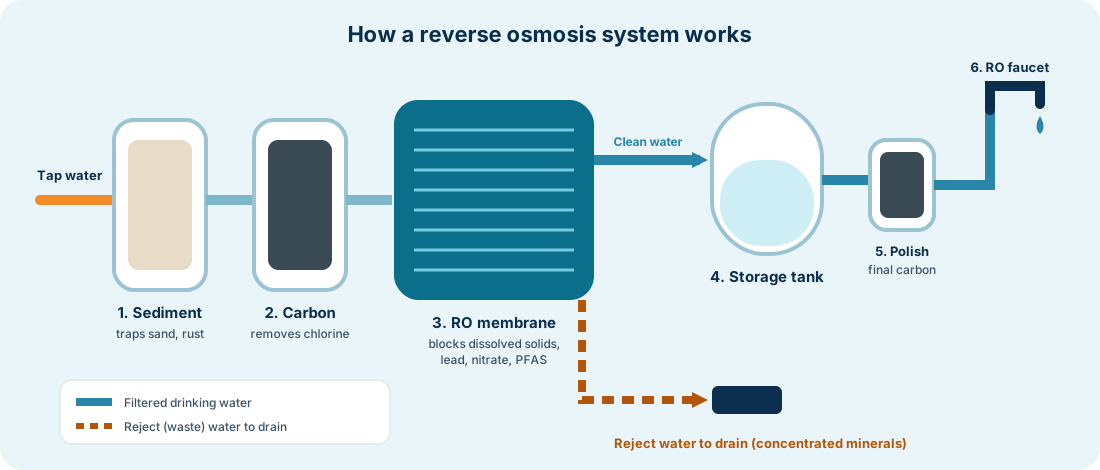
An under-sink reverse osmosis system removes a wide range of contaminants along with PFAS, including lead, nitrate and arsenic. It wastes some water and needs filter and membrane changes.
Carbon filters: cheaper, but check the claim
Many pitcher, faucet and under-sink carbon filters only improve taste and chlorine. Only those certified for PFOA/PFOS reduction should be relied on for PFAS. Carbon fills up over time, so changing it on schedule matters even more.
Whole-house PFAS treatment
Whole-house carbon or ion exchange systems can reduce PFAS at every tap, but they cost more and need careful sizing. For most homes, PFAS exposure comes mainly from drinking and cooking, so point-of-use filters are the usual first step. Learn more in our whole house water filtration guide.
How to Choose a PFAS Water Filter
- Check the certification listing. Look for NSF/ANSI 53 or 58 with a PFAS (usually PFOA/PFOS) reduction claim, and confirm it in the directory of an accredited certifier: NSF, WQA, IAPMO, CSA Group or UL.
- Match the filter to how much water you drink. A pitcher is fine for one person; an under-sink system suits a family.
- Count the maintenance cost. Replacement cartridges and membranes add up.
- Know the limits. The EPA notes that, as of 2024, certifications mainly cover PFOA and PFOS and do not yet confirm removal down to EPA’s new limits.
Comparing all your options? See our guide to the types of water filters.
EPA PFAS Rules: Where Things Stand
In April 2024 the EPA set the first national drinking water limits for PFAS, including 4 parts per trillion for PFOA and PFOS. Since then the rule has changed:
- In May 2025, EPA said it would keep the PFOA and PFOS limits but give water systems more time.
- In May 2026, EPA formally proposed moving the PFOA/PFOS compliance deadline to 2031 and rescinding the limits for four other PFAS (PFHxS, PFNA, GenX and a mixture standard).
- The rule is being challenged in federal court, and oral arguments were held in September 2026.
Rules may keep changing, so if PFAS are a concern for your home, a certified filter is something you can control today.
Frequently Asked Questions
What is the best water filter for PFAS?
The EPA says reverse osmosis, granular activated carbon and ion exchange filters can greatly reduce PFAS. Under-sink reverse osmosis is usually the most thorough option for drinking water. Whatever you choose, look for certification to NSF/ANSI 53 or 58 with a PFAS (PFOA/PFOS) reduction claim.
Does boiling water remove PFAS?
No. Boiling does not remove PFAS. Because water evaporates while PFAS stay behind, boiling can slightly concentrate them.
Do pitcher filters remove PFAS?
Some do. A few pitcher and faucet filters are certified to reduce PFOA and PFOS. Check the product’s certification listing for a specific PFAS claim, and replace the cartridge on schedule.
How do I know if my water has PFAS?
City water customers can check their annual water quality report or contact their utility. If you have a private well, the only way to know is to test it with a certified laboratory.
What is the EPA limit for PFAS in drinking water?
In 2024 the EPA set enforceable limits of 4 parts per trillion for PFOA and PFOS. As of late 2026, EPA has proposed giving water systems until 2031 to comply and has proposed rescinding limits for four other PFAS, and the rule is being challenged in court.
The Bottom Line
To remove PFAS from tap water, use a filter certified for PFAS reduction: reverse osmosis is the most thorough, and certified carbon or ion exchange filters cost less. Check your water quality report or test your well first, confirm the certification claim and replace filters on time. Do not rely on boiling.
Sources: EPA: Identifying drinking water filters certified to reduce PFAS; EPA: Reducing PFAS in your drinking water with a home filter (fact sheet); Harvard EELP: PFAS in drinking water regulatory tracker; NSF: Filtration standards.