Reverse Osmosis Tank: Sizes, Pressure and Troubleshooting
Last updated: November 6, 2026 · Sources: EPA WaterSense, manufacturer manuals
A reverse osmosis tank is a small pressurized storage tank, usually under the kitchen sink, that holds filtered water from an RO system so you can fill a glass quickly. Inside, a rubber bladder separates the water from compressed air. When you open the RO faucet, the air pushes the water out. Most home tanks are set to roughly 5 to 8 psi of air pressure when empty.
RO membranes filter water slowly, drop by drop, so without a tank you would wait a long time for each glass. This guide explains how an RO tank works, which size you need, how to check and set the pressure, how to fix common problems and when to replace it.
RO tank at a glance
- What it does: stores filtered water and pushes it to the RO faucet
- How it works: a bladder with water on one side and air on the other
- Air pressure: often about 5 to 8 psi when empty (check your manual)
- Usable water: less than the tank’s total size
- Most common problem: low air pressure, causing weak flow
How a Reverse Osmosis Tank Works
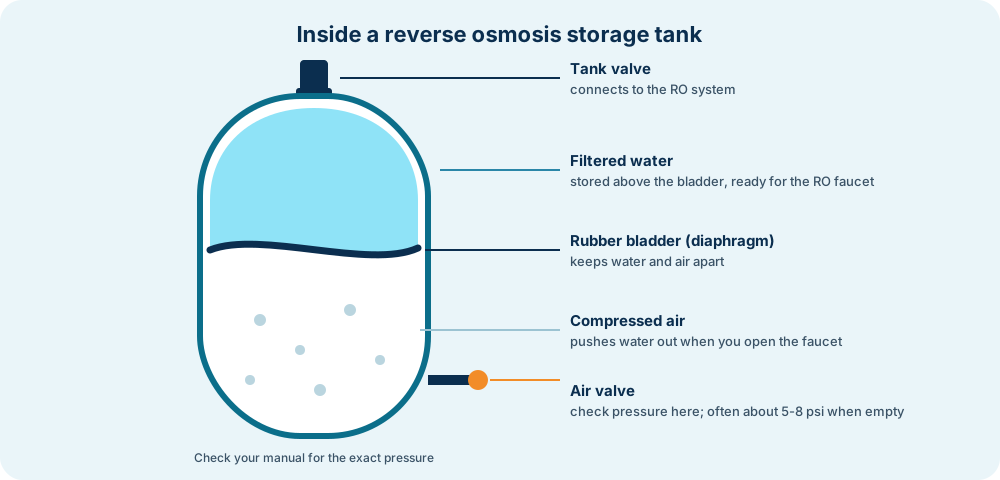
Your reverse osmosis system sends filtered water into the top of the tank. As the tank fills, the water squeezes the bladder and compresses the air below it. When you open the RO faucet, the compressed air pushes the water back out. When the tank is full, a shut-off valve stops the system from making more water.
Because the air takes up space, a tank never holds as much usable water as its total size. As the tank empties, the pressure drops and the flow slows.
RO Tank Sizes: Which One Do You Need?
| Tank type | Best for | Notes |
|---|---|---|
| Small (about 2 to 3 gallons total) | 1 to 3 people, small cabinets | The most common under-sink size |
| Standard (about 3 to 4 gallons total) | Families, ice makers, cooking | Fits most kitchen cabinets |
| Large (10+ gallons total) | Big households, multiple taps | Usually goes in a basement |
| Tankless RO | Small spaces, on-demand water | Uses a pump and needs an outlet |
Tank sizes describe total volume, not usable water. Expect only part of that to come out of the faucet. If you often run out, a larger tank or a second tank can help, but the membrane still needs time to refill it.

How to Check and Set RO Tank Pressure
Low air pressure is the most common reason for weak flow from an RO faucet. To check it you need a simple tire pressure gauge, and a bike pump if you need to add air.
- Turn off the water supply to the RO system.
- Open the RO faucet and let the tank drain completely until the flow stops.
- Remove the cap on the air valve on the side or bottom of the tank.
- Check the pressure with the gauge. Most tanks should read around 5 to 8 psi when empty; follow your manual.
- Add air with a bike pump if it is low, checking as you go. Do not over-inflate.
- Close the faucet and turn the water back on. Let the tank refill for a few hours before testing.
Always check the pressure with the tank empty. A reading taken while the tank holds water will be too high and misleading.
Common RO Tank Problems and Fixes
| Problem | Likely cause | Fix |
|---|---|---|
| Weak or slow flow from the faucet | Low air pressure in the tank | Drain the tank and add air to the correct psi |
| Tank feels full but little water comes out | Too much air pressure, or a failed bladder | Drain, check the psi, and replace the tank if it will not hold air |
| Water comes out of the air valve | Ruptured bladder | Replace the tank |
| Tank takes forever to fill | Low household water pressure, clogged filters or a worn membrane | Change the pre-filters, check the membrane, consider a booster pump |
| Drain water runs constantly | Faulty automatic shut-off valve or check valve | Replace the shut-off or check valve |
| Bad taste from the tank | Water sitting too long, or an old post-filter | Sanitize the system and replace the post-filter |

How to Clean and Sanitize an RO Tank
Many manufacturers recommend sanitizing the RO system and tank about once a year, usually when you change the filters. The exact steps depend on your system, but the general process is:
- Shut off the water and drain the tank.
- Remove the filters and membrane as your manual describes.
- Add the sanitizer your manufacturer recommends to the first filter housing.
- Turn the water back on, let the tank fill, and let it sit for the recommended time.
- Drain the tank completely, then reinstall new filters and the membrane.
- Fill and drain the tank once or twice more before drinking the water.
When to Replace an RO Tank
- It will not hold air pressure even after you add air
- Water comes out of the air valve
- The tank is cracked, rusted or leaking
- It is many years old and flow keeps getting weaker
Replacement tanks are standard sizes with standard fittings, so you can usually buy one that fits your system. Make sure the connector size matches.
Tank vs. Tankless Reverse Osmosis
| With a tank | Tankless | |
|---|---|---|
| Upfront cost | Lower | Higher |
| Space under the sink | More | Less |
| Needs electricity | No | Yes |
| Flow when you need lots of water | Fast until the tank runs low | Steady, but limited by the pump |
| Water waste | Often higher | Often lower |
To cut water waste with any RO system, look for the EPA WaterSense label, which limits reject water to 2.3 gallons per gallon of treated water.

Frequently Asked Questions
What should the air pressure be in an RO tank?
Most residential RO tanks are set to roughly 5 to 8 psi of air pressure when the tank is completely empty of water. Always check your tank or system manual for the exact number, and only measure after draining the tank.
How long does a reverse osmosis tank last?
Many RO tanks last several years, often five to ten, depending on water quality and use. Replace the tank if the bladder fails, it cannot hold air pressure, or water comes out of the air valve.
How long does it take an RO tank to fill?
It usually takes a few hours to refill a typical under-sink tank from empty, because RO membranes make water slowly. Low incoming water pressure, cold water or a worn membrane make it slower.
Why is my RO tank full but has no water pressure?
The most common cause is low air pressure in the tank. Drain the tank, check the air valve with a gauge and add air if needed. If the tank will not hold air or water comes out of the air valve, the bladder has failed and the tank needs replacing.
Do I need a tank for a reverse osmosis system?
Not always. Traditional RO systems need a storage tank because they filter slowly. Tankless RO systems use an electric pump to filter on demand, so they save space but cost more and need an outlet.
The Bottom Line
An RO tank stores filtered water and uses air pressure to push it to your faucet. Pick a size that fits your household and cabinet, keep the air pressure around what your manual recommends (often 5 to 8 psi when empty), sanitize it when you change filters and replace it when the bladder fails. Most RO flow problems are fixed with a simple pressure check.
Sources: EPA WaterSense: Point-of-Use Reverse Osmosis Systems. Pressure and maintenance steps vary by manufacturer; always follow your system’s manual.