Whole House Water Filtration System: Types, Cost and How to Choose
Last updated: November 6, 2026 · Sources: EPA, NSF, Angi
A whole house water filtration system is installed where the main water line enters your home and filters the water for every faucet, shower and appliance. Most systems use a sediment filter followed by a carbon filter to remove dirt, chlorine, chloramine, bad taste and odor. A typical system costs about $1,100 to $3,500 installed, with a national average of about $2,273.
Unlike a pitcher or under-sink filter, a whole house filter protects your showers, laundry and water heater too. But it is not always the right choice, and it does not fix every water problem. This guide explains how whole house water filters work, the main types, how to size one, what it costs and whether you actually need one.
Whole house water filter at a glance
- What it is: a point-of-entry (POE) filter on your main water line
- Usually removes: sediment, chlorine, chloramine, taste and odor, some chemicals
- Does not remove: hardness (you need a softener for that)
- Average cost: about $2,273 installed (typical range $1,129 to $3,540)
- Look for: NSF/ANSI 42 or 53 certification and the right flow rate for your home
What Is a Whole House Water Filtration System?
A whole house water filter, also called a point-of-entry (POE) system, treats all the water coming into your home before it splits off to the kitchen, bathrooms, laundry and water heater. That is different from point-of-use (POU) filters, like pitchers, faucet filters and under-sink units, which only treat water at one tap.
Most systems are installed in a basement, garage or utility room, right after the main shut-off valve. If you also have a water softener, the filter usually goes before it.
How a Whole House Water Filter Works
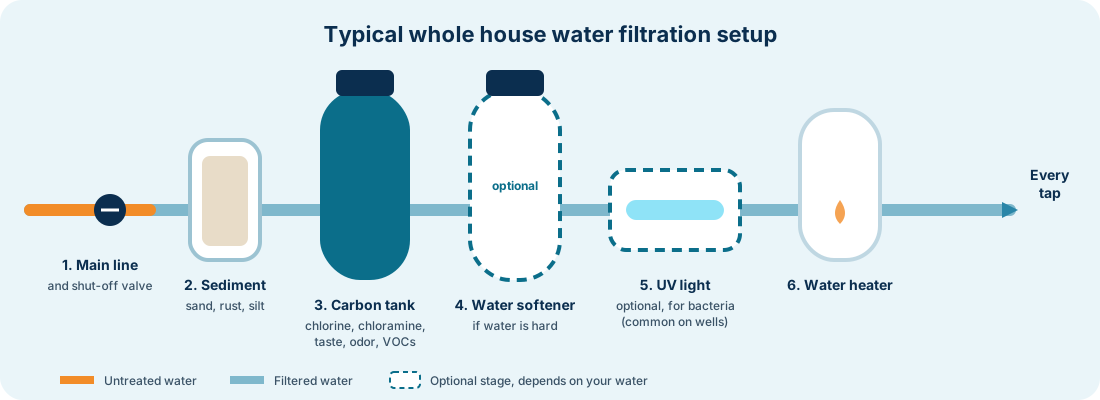
Water passes through the system in stages:
- Sediment filter: catches sand, rust and silt so they do not clog the next stages or your fixtures.
- Carbon filter: activated carbon (or catalytic carbon for chloramine) removes chlorine, bad taste and odor and many organic chemicals.
- Optional stages: a water softener for hard water, an iron or sulfur filter for well water, or a UV light to kill bacteria.
Types of Whole House Water Filters
| Type | What it removes | Best for |
|---|---|---|
| Sediment filter | Sand, rust, silt, dirt | Well water, older pipes; protects other stages |
| Activated carbon | Chlorine, taste, odor, many VOCs | Most city water homes |
| Catalytic carbon | Chloramine, chlorine, some sulfur odor | Cities that use chloramine |
| Iron and sulfur filter | Iron, manganese, rotten-egg smell | Private wells |
| UV purifier | Bacteria and viruses | Wells or boil-water concerns |
| Whole house reverse osmosis | Most dissolved solids and contaminants | Special cases; costly and needs storage |
There are also two main designs. Cartridge systems use filter housings with replaceable cartridges. They are cheaper up front but need cartridge changes several times a year. Tank systems hold a large bed of filter media and often backwash themselves, so they cost more but can last for years before the media is replaced.
Whole House Water Filter Cost
According to Angi, a whole house water filtration system costs about $2,273 on average, and most homeowners pay between $1,129 and $3,540 installed. Here is what different systems typically cost, including professional installation:
| System | Typical installed cost |
|---|---|
| UV purifier | $500 to $1,500 |
| Carbon filter | $800 to $1,500 |
| Well water filter | $1,000 to $4,000 |
| Whole house reverse osmosis | $1,000 to $4,800 |
| Installation labor alone | $300 to $500 |
| Plumbing permit (if required) | $50 to $500 |
Do not forget ongoing costs. Cartridge systems need new filters regularly, and tank systems eventually need new media. Ask for the yearly maintenance cost before you buy. For softeners, see our water softener cost guide.
Do You Need a Whole House Water Filter?
A whole house system makes sense when the problem shows up at every tap, not just in your drinking glass:
- Chlorine or chloramine smell in showers and baths
- Sediment clogging aerators, shower heads or appliances
- Iron stains or rotten-egg odor from well water
- A private well with problems confirmed by a lab test
If your only concern is drinking water, an under-sink filter or reverse osmosis system is far cheaper. And if your problem is scale, spots and dry skin, you need a water softener, not a filter. Compare all the options in our guide to types of water filters.
How to Choose a Whole House Water Filter
- Test your water first. City water customers can read the annual water quality report. Well owners should test with a certified lab. You cannot pick the right media without knowing the problem.
- Match the media to the problem. Carbon for chlorine, catalytic carbon for chloramine, iron filters for iron, UV for bacteria.
- Size it for your flow rate. The system must keep up when several taps run at once. Larger homes with more bathrooms need higher flow ratings and often 1-inch ports. Ask the installer to size it to your peak use.
- Check certification. Look for NSF/ANSI 42 for chlorine, taste and odor, or NSF/ANSI 53 for health-related contaminants, from an accredited certifier.
- Compare maintenance. Cartridge cost and how often you replace them can matter more than the purchase price.

Installation: DIY or Professional?
Installing a whole house filter means cutting into your main water line, adding shut-off and bypass valves, and sometimes running a drain line or electrical outlet for backwashing or UV systems. Handy homeowners can install simple cartridge systems, but many people hire a plumber, especially for tank systems, well water treatment or homes that need a permit.

Whichever route you choose, install a bypass valve so you can service the system without losing water, and keep outdoor faucets on unfiltered water if you want to save filter life.
Maintenance
- Sediment cartridges: replace when pressure drops or on the maker’s schedule, often every few months.
- Carbon cartridges or media: replace on schedule. Carbon stops working once it is full, even if water still flows.
- UV lamps: usually replaced about once a year; clean the quartz sleeve.
- Tank systems: check that the backwash cycle is running and the settings are correct.
The EPA notes that filters only work when they are maintained according to the manufacturer’s instructions.
Pros and Cons of a Whole House Water Filter
| Pros | Cons |
|---|---|
| Filtered water at every tap and shower | Higher upfront cost than point-of-use filters |
| Protects plumbing, fixtures and appliances from sediment | Needs installation on the main line |
| Removes chlorine smell in showers and laundry | Does not remove hardness |
| Can be customized for well water problems | May not remove lead or PFAS as well as RO |
Frequently Asked Questions
Is a whole house water filtration system worth it?
It is worth it when a problem affects every tap, such as chlorine or chloramine smell in showers, sediment, iron stains or sulfur odor, or when you have a private well. If you only care about drinking water, an under-sink filter or reverse osmosis system costs much less.
How much does a whole house water filter cost?
Angi puts the national average at about $2,273 installed, with most homeowners paying $1,129 to $3,540. Carbon systems typically run $800 to $1,500 installed, and well water or whole-house reverse osmosis systems can cost $1,000 to $4,800.
Does a whole house water filter remove hard water?
No. Most whole house filters, including carbon and sediment filters, do not remove calcium and magnesium. To treat hard water for the whole home, add a water softener, usually after the sediment and carbon stages.
Will a whole house filter lower my water pressure?
A correctly sized system causes only a small pressure drop. Undersized systems, small 3/4-inch ports or clogged sediment cartridges are the usual causes of noticeable pressure loss.
Do I still need a drinking water filter with a whole house system?
Often, yes. Whole house filters focus on chlorine, sediment and taste. For lead, PFAS, nitrate or fluoride in drinking water, many homes add an under-sink reverse osmosis system at the kitchen tap.
The Bottom Line
A whole house water filtration system is the best choice when your water problem affects every tap: chlorine smell, sediment, iron or sulfur. Test your water first, choose the filter media that matches the problem, size it for your home’s flow rate and pick a certified system. Pair it with a water softener for hard water and an under-sink RO filter if you need the cleanest possible drinking water.
Sources: Angi: Whole house water filtration system cost; NSF: NSF/ANSI 42, 53 and 401 standards; EPA: Water filter fact sheet; EPA: Consumer Confidence Reports.