Water Test Results Checker: What Do Your Numbers Mean?
Last updated: November 6, 2026 · Sources: U.S. EPA
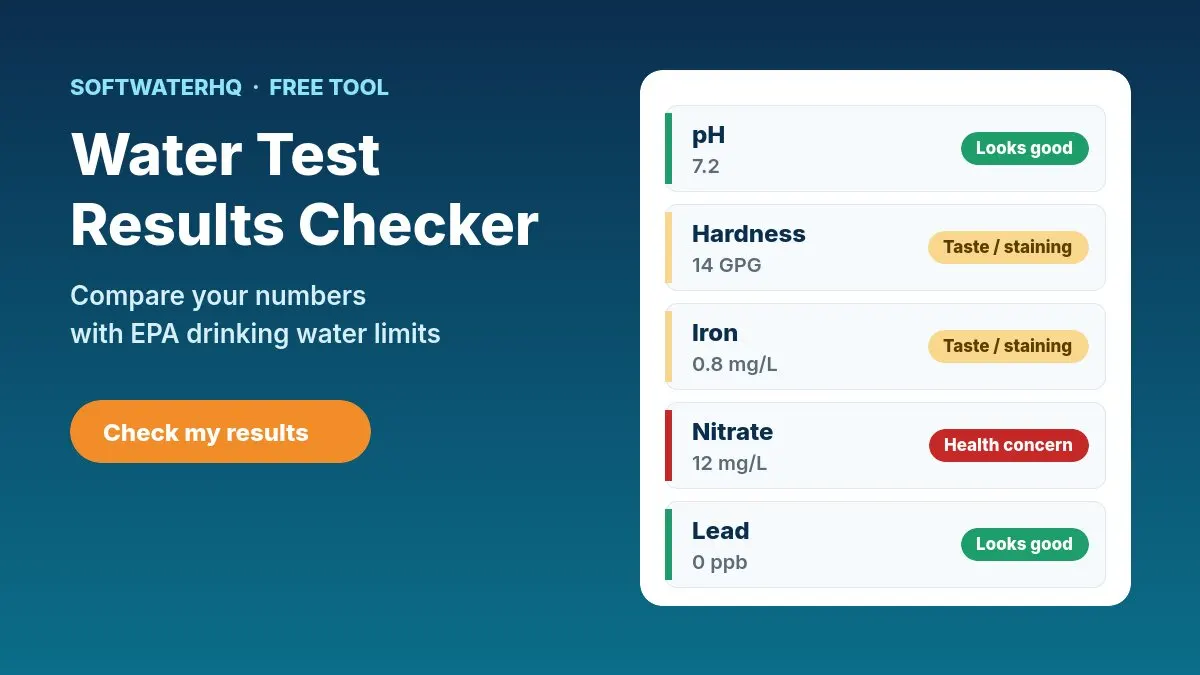
Got your water test results and not sure what the numbers mean? Enter them in the free checker below. It compares each result with U.S. EPA drinking water limits and tells you, in plain English, whether it looks fine, is only a taste or staining issue, or is a health concern, plus what to do next.
Quick guide to your results
- Health concern: above an EPA legal limit (for example nitrate, lead, arsenic or bacteria). Retest with a certified lab and act quickly.
- Taste / staining: above an EPA secondary guideline (for example iron, pH or TDS). Annoying, but not usually a health risk.
- Hardness: has no EPA limit. It causes scale, not health problems.
Based on U.S. EPA drinking water standards. This checker is for information only and does not replace a certified lab. If a result is marked as a health concern, retest with a state-certified lab and contact your local health department or water utility.
How to Use the Water Test Results Checker
- Find your numbers. Use a home test strip or kit, a certified lab report, or your city’s annual water quality report.
- Check the units. Most results are in mg/L, which is the same as ppm. Lead and arsenic are often in ppb (µg/L); pick the matching unit in the drop-down. PFAS results are in ppt (ng/L).
- Enter only what you tested. Leave the rest blank.
- Press “Check my results.” Results are sorted with the most serious first, each with a short explanation and a link to the right fix.
Nothing you type is stored or sent anywhere. The checker runs entirely in your browser.
EPA Limits Used by This Checker
| Test | EPA limit | Type | Main concern |
|---|---|---|---|
| pH | 6.5 to 8.5 | Secondary | Corrosion, taste, scale |
| Hardness | None | – | Scale and spotting |
| Total dissolved solids (TDS) | 500 mg/L | Secondary | Taste |
| Chlorine | 4 mg/L | Maximum (MRDL) | Health at high levels |
| Iron | 0.3 mg/L | Secondary | Orange stains, metallic taste |
| Manganese | 0.05 mg/L (0.3 mg/L health advisory) | Secondary | Black stains; health at high levels |
| Lead | Goal 0; action level 15 ppb (10 ppb from 2027) | Action level | Health, especially children |
| Copper | 1.3 mg/L (1.0 mg/L secondary) | Action level | Stomach upset, blue-green stains |
| Arsenic | 10 ppb | Maximum (MCL) | Long-term health risk |
| Nitrate (as N) | 10 mg/L | Maximum (MCL) | Dangerous for infants |
| Nitrite (as N) | 1 mg/L | Maximum (MCL) | Dangerous for infants |
| Fluoride | 4 mg/L (2 mg/L secondary) | Maximum (MCL) | Bone and dental effects |
| Sulfate | 250 mg/L | Secondary | Bitter taste, laxative effect |
| Chloride | 250 mg/L | Secondary | Salty taste, corrosion |
| PFOA and PFOS | 4 ppt each | Maximum (MCL) | Long-term health risk |
| Total coliform and E. coli | Must be absent | Maximum (MCL) | Illness from bacteria |
Primary vs. Secondary Standards: What Is the Difference?
The EPA sets two kinds of drinking water standards. Primary standards (maximum contaminant levels, or MCLs, plus action levels for lead and copper) protect your health and are legally enforceable for public water systems. Secondary standards cover taste, smell, color and staining. They are guidelines, not health limits.
Private wells are not regulated by the EPA, so well owners are responsible for testing and treating their own water. These limits are still the best yardstick to use. See our guide to well water testing.
What to Do If a Result Is High
If you see a health concern
- Confirm it. Home strips are screening tools. Retest with a state-certified lab before buying equipment.
- Protect infants first. Do not use water high in nitrate, nitrite or manganese for baby formula. Boiling does not remove nitrate; it concentrates it.
- Bacteria: boil water for drinking, then disinfect the well and retest.
- Call the right people. On city water, contact your utility. On a well, your local health department can help.
If you see a taste or staining issue
- Hardness: a water softener removes it. See what size water softener you need.
- Iron and manganese: see how to remove iron from well water.
- High TDS, sulfate or fluoride: reverse osmosis treats drinking water at one tap.
- Several problems at once: compare whole house water filtration systems.
Where to Get Your Numbers
- City water: your utility’s annual water quality report lists most of these results.
- Home testing: strips and kits cover pH, hardness, chlorine, iron, nitrate and more. See how to test water hardness at home.
- Lab testing: needed for lead, arsenic, PFAS and bacteria.
- Just want your hardness? Try our water hardness by ZIP code lookup.
Frequently Asked Questions
What is a normal pH for drinking water?
The EPA recommends a pH between 6.5 and 8.5. Water below 6.5 is acidic and can corrode pipes; water above 8.5 can taste bitter and add to scale.
Is mg/L the same as ppm?
Yes. For drinking water, 1 mg/L equals 1 part per million (ppm). 1 mg/L also equals 1,000 ppb (µg/L).
What water test results are dangerous?
Results above an EPA primary limit are a health concern. The most urgent are E. coli or total coliform bacteria, nitrate above 10 mg/L, lead at or above the action level, and arsenic above 10 ppb.
Are home water test strips accurate?
Test strips are good for screening and for tracking changes over time, but they are less precise than a lab. Confirm any worrying result with a state-certified lab.
Does hard water have an EPA limit?
No. The EPA sets no limit for hardness because calcium and magnesium are not a health risk. Hardness is mainly a scale and cleaning problem.
Sources: EPA: National Primary Drinking Water Regulations; EPA: Secondary Drinking Water Standards; EPA: Lead and Copper Rule Improvements; EPA: PFAS drinking water regulation.