Water Softener Settings: How to Set Hardness, Regeneration and Salt
Last updated: November 7, 2026 · Sources: USGS, Water Quality Association, manufacturer manuals
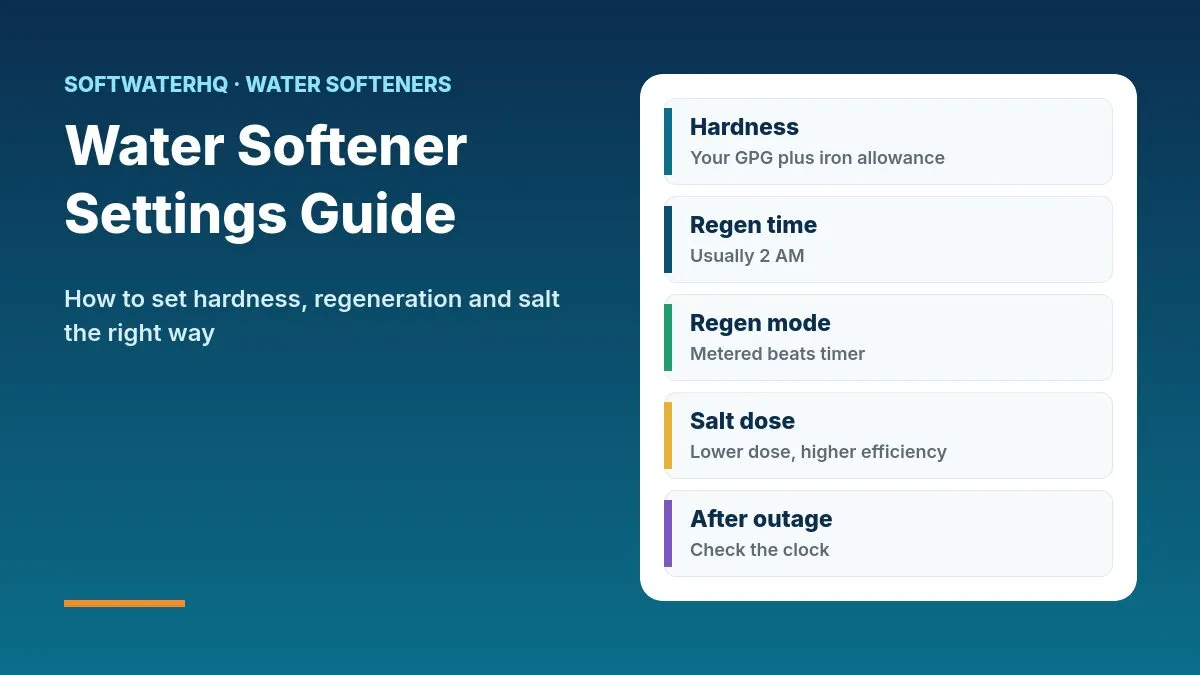
The most important water softener setting is hardness. Set it to your water’s hardness in grains per gallon (GPG), and add about 4 GPG for each 1 mg/L of iron. Then set the regeneration time (usually 2 AM), choose metered (demand) regeneration if your softener offers it, and use a moderate salt dose for better efficiency. After a power outage, reset the clock so the softener regenerates at night.
A softener that is set wrong either wastes salt and water or lets hard water slip through. The good news is that most of the settings are simple once you know what they mean. This guide explains every common water softener setting, how to find the right hardness number and what to do if your water still feels hard.
Water softener settings at a glance
- Hardness: your GPG, plus about 4 GPG per 1 mg/L of iron
- mg/L to GPG: divide by 17.1
- Regeneration time: 2 AM is the usual default
- Regeneration mode: metered (demand) is most efficient
- Salt dose: lower doses save salt; higher doses add capacity
- After an outage: check the time of day
The Settings on a Typical Water Softener
| Setting | What it controls | Typical value |
|---|---|---|
| Hardness | How fast the softener counts down its capacity | Your water’s hardness in GPG (plus iron allowance) |
| Time of day | The softener’s clock | Current local time |
| Regeneration time | When the cycle starts | 2:00 AM |
| Regeneration mode | Timer, metered delayed or metered immediate | Metered delayed |
| Days override | Maximum days between cycles, even with low use | 7 to 14 days |
| Capacity | How many grains the resin holds per regeneration | Set by the installer from resin size and salt dose |
| Salt dose / salt setting | Pounds of salt used per regeneration | About 6 to 10 lb per cubic foot of resin for efficiency |
| Reserve capacity | Capacity held back so you don’t run out before 2 AM | Often automatic, or about one day’s use |
Not every softener shows all of these. Many newer units only ask for hardness, time and regeneration time, and calculate the rest. Advanced valves such as the Fleck 5600SXT or Clack WS1 let installers adjust capacity, salt dose and cycle times.
How to Set the Hardness on a Water Softener
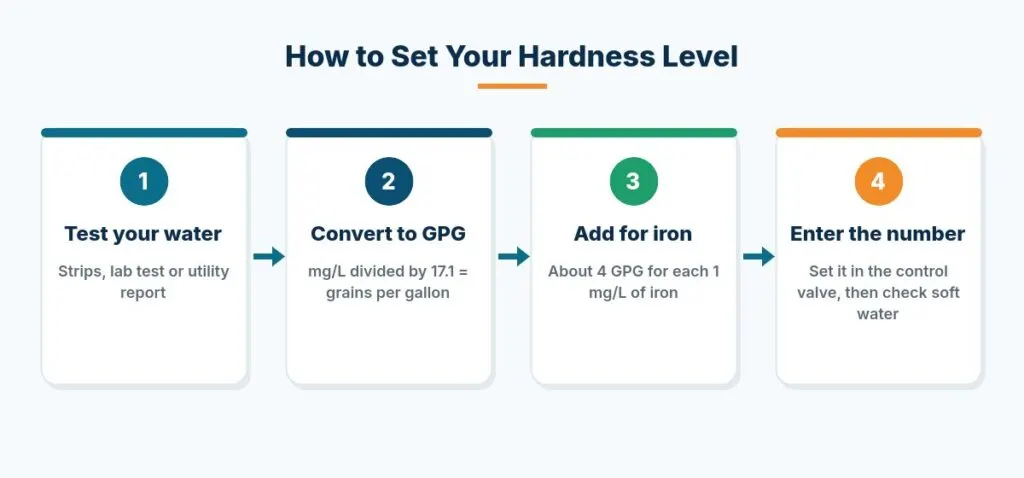
Step 1: Test your water
Use hardness test strips, a drop-count kit, a lab test or your water utility’s annual water quality report. See how to test water hardness, or get an estimate from our water hardness by ZIP code lookup.
Step 2: Convert to grains per gallon
Most softeners use GPG. If your result is in mg/L or ppm (as calcium carbonate), divide by 17.1. For example, 256 mg/L ÷ 17.1 = 15 GPG.
Step 3: Add an allowance for iron
Iron and manganese use up resin capacity too. A common rule is to add about 4 GPG for each 1 mg/L of iron. With 15 GPG hardness and 1 mg/L of iron, set the softener to about 19 GPG. This is called compensated hardness; see water softeners for well water for details.
Step 4: Enter it and check
Enter the number in the control valve’s hardness setting. After a few days, test the softened water at a tap. It should read close to 0 GPG. If it still shows hardness, see the troubleshooting section below.
What Does a Hardness Setting of 25 Mean?
A hardness setting is simply a number in grains per gallon. A setting of 25 means the softener assumes every gallon carries 25 grains of hardness, which is very hard water (about 428 mg/L). The softener uses that number with your water meter to know when the resin is full. Setting 25 when your water is really 15 GPG will not make your water “softer”; it will just make the softener regenerate more often and use more salt.
What If the Hardness Is Set Too High or Too Low?
| Setting | What happens |
|---|---|
| Too high | Regenerates more often than needed; wastes salt and water. Water is still soft. |
| Too low | Waits too long to regenerate, so hard water breaks through before the next cycle. |
| About right | Soft water all the time with the least salt and water. |
Many installers add 1 to 3 GPG above the measured hardness as a small safety margin.
Regeneration Time and Mode
Set regeneration for a time when no one uses water. 2 AM is the default on most units. If someone in your home showers at 2 AM, move it to 3 or 4 AM. Choose metered delayed regeneration if available: the softener tracks your water use and regenerates that night only when capacity is low. Learn how the cycle works in our water softener regeneration guide.
Timed models have programmable timeclocks that will regenerate on a predetermined schedule and then return to service. These work well for households that are on regular water-using cycles but will waste more water and salt because they regenerate whether the resin needs it or not.
Salt Dose and Efficiency Settings
A higher salt dose recovers more resin capacity but uses salt less efficiently. Many modern softeners have an “efficiency” or “salt saver” mode that uses a lower dose and regenerates a little more often, which usually saves salt over a year. If you switch from sodium chloride to potassium chloride, increase the salt setting slightly, since potassium is less efficient. More on salt in our water softener salt guide.
Example Settings by Hardness
These assume a family of four (about 300 gallons a day) and no iron. Your installer or manual may suggest different values.
| Water hardness | Hardness setting | Grains used per day | Suggested softener size |
|---|---|---|---|
| 7 GPG (moderately hard) | 8 GPG | About 2,400 | 24,000 to 32,000 grain |
| 12 GPG (hard) | 13 GPG | About 3,900 | 32,000 to 40,000 grain |
| 18 GPG (very hard) | 19 GPG | About 5,700 | 48,000 grain |
| 25 GPG (extremely hard) | 26 GPG | About 7,800 | 64,000 grain |
Use our water softener sizing guide for your exact household.
How to Reset a Water Softener
- After a power outage: most valves keep their settings but may lose the time. Set the correct time of day so regeneration still happens at night.
- Soft reset: unplug the softener for about 30 seconds and plug it back in, then check the time.
- Factory reset: only if settings are corrupted. You will need to re-enter hardness and other values, so write them down first. Steps vary by brand; check the manual.
Water Still Hard After Setting the Softener?
- Make sure the bypass valve is in the service position.
- Check for salt in the brine tank and break up any salt bridge.
- Confirm the hardness setting and time of day.
- Run a manual regeneration, then retest after a few hours.
- If hardness keeps breaking through, the resin may be worn out or fouled by iron.
For more fixes, see common water softener problems.
Frequently Asked Questions
What should I set my water softener hardness to?
Set it to your water’s hardness in grains per gallon, plus about 4 GPG for each 1 mg/L of iron. Many installers add 1 to 3 GPG as a small buffer.
How do I convert mg/L or ppm to grains per gallon?
Divide mg/L (or ppm) by 17.1. For example, 171 mg/L is 10 GPG, and 342 mg/L is 20 GPG.
What happens if I set my water softener hardness too high?
Your water stays soft, but the softener regenerates more often than it needs to, wasting salt and water. Lower it to your actual hardness plus a small buffer.
What time should a water softener regenerate?
Most homes use 2 AM, when no one is using water. Pick any time when water use is lowest, because a single-tank softener sends hard water to the house during regeneration.
Do I need to reset my water softener after a power outage?
Usually you only need to reset the time of day. Most modern valves keep the hardness and other settings in memory.
Sources: USGS: Hardness of Water; NSF: Standards for Water Treatment Systems.