Water Softener for Well Water: How to Choose and Size One
Last updated: November 6, 2026 · Sources: U.S. EPA, university Extension guidance
A water softener works well on well water, but you have to size it differently than for city water. Test for hardness, iron, manganese and pH first. Then add about 4 grains per gallon (GPG) to your hardness for every 1 mg/L of iron to get your “compensated hardness,” and size the softener from that number. Put a sediment filter in front of it, and make sure your well pump can deliver the softener’s backwash flow rate.
Well water is often harder than city water, and it usually comes with extras like iron, manganese, sand and low pH. A softener that is sized and set up for city water can clog, stain orange or run out of capacity in days. This guide shows how to choose a water softener for well water that actually lasts.
Well water softener at a glance
- Test first: hardness, iron, manganese, pH, TDS and bacteria
- Compensated hardness: hardness + about 4 GPG per 1 mg/L of iron
- Iron limit: softeners handle only small amounts of clear-water iron
- Before the softener: sediment filter; neutralizer and iron filter if needed
- Check: your pump’s flow rate against the softener’s backwash rate
Do You Need a Water Softener for Well Water?
You probably do if your hardness is above about 7 GPG (120 mg/L) and you see the usual signs: white scale on faucets, spotty dishes, soap scum and dry skin. Many wells in the Midwest, Great Plains and Southwest test well above 15 GPG. Hard water is not a health risk, but it shortens the life of water heaters and appliances. Read what is hard water for the full picture, or check typical levels near you with our water hardness by ZIP code tool.
Test These Six Things Before You Buy
| Test | Why it matters for a softener |
|---|---|
| Hardness | Sets the size of the softener and its hardness setting |
| Iron | Adds to the load; too much fouls the resin |
| Manganese | Acts like iron and causes black stains |
| pH | Below 6.5 needs a neutralizer before the softener |
| TDS | Very high TDS can reduce softener efficiency |
| Bacteria and sulfur | Iron or sulfur bacteria can slime the resin; fix them first |
Use a certified lab rather than test strips for iron and manganese, because small differences change the size you need. Our well water testing guide explains how.
How Well Water Changes Softener Sizing
A softener captures iron and manganese in the same resin it uses for hardness, so they use up capacity. A common rule of thumb is to add about 4 GPG of hardness for every 1 mg/L (ppm) of iron, and to count manganese the same way. This total is called compensated hardness.

Then work out your daily load: people × 75 gallons × compensated hardness. For a family of four with 15 GPG hardness and 2 mg/L of iron, that is 4 × 75 × 23 = 6,900 grains per day, or about 48,000 grains per week. That family needs a much bigger softener than the 15 GPG number alone suggests. Use our step-by-step water softener sizing guide to pick a capacity.
Can a Water Softener Remove Iron From Well Water?
Yes, but only a limited amount, and only the right kind. A softener can remove small amounts of ferrous (clear-water) iron, the kind that comes out of the tap clear and turns orange after sitting. Many manufacturers rate their softeners for a few mg/L; check the specific model.
A softener should not be your iron filter if:
- The water comes out of the tap already orange or cloudy (ferric iron)
- You have iron bacteria (slimy red-brown buildup in the toilet tank)
- Your iron level is higher than the softener’s rating
In those cases, install an iron filter before the softener. See how to remove iron from well water. If you do use a softener for low iron, choose fine-mesh resin and use a softener resin cleaner regularly to keep iron from building up.
Check Your Well Pump’s Flow Rate
Softeners clean themselves by backwashing, and each size needs a minimum flow rate in gallons per minute (GPM) to do it properly. If your pump cannot deliver that flow, the resin bed will not clean properly and will slowly foul.
Simple bucket test: with the pump running, time how long it takes to fill a 5-gallon bucket from an outdoor spigot. Divide 300 by the number of seconds to get GPM. For example, 30 seconds = 10 GPM. Compare that number to the backwash rate on the softener’s spec sheet, and leave some margin.
What to Install Before and After the Softener
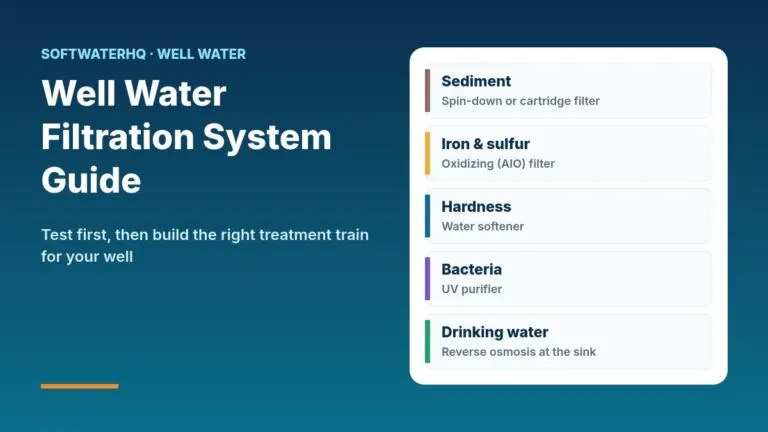
Install everything after the well’s pressure tank, in this order:
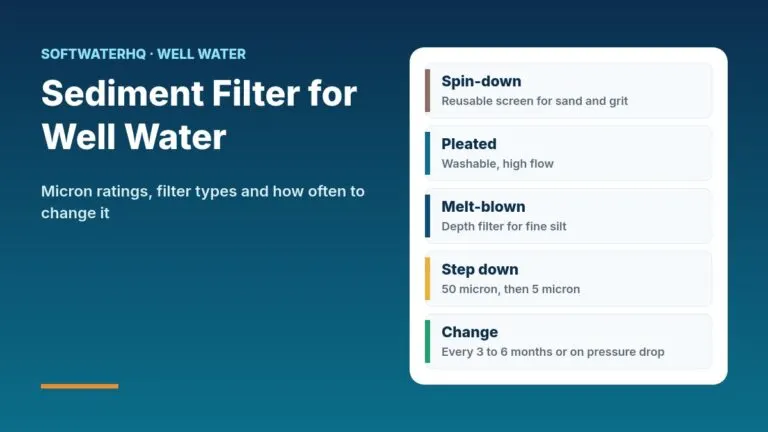
- Sediment filter to protect the control valve and resin from sand.
- Acid neutralizer if pH is below about 6.5. Calcite adds hardness, so the softener must come after it.
- Iron and sulfur filter if iron is above what the softener can handle or you have a sulfur smell.
- Water softener.
- UV purifier if you need disinfection, placed last.
Our well water filtration system guide explains each stage in detail.
For the plumbing itself, including the bypass valve, drain line and air gap, follow our step-by-step guide to water softener installation.
What to Look For in a Water Softener for Well Water
Whatever brand you consider, check these features. They matter more on a well than on city water.
- Capacity sized to compensated hardness: many well homes need 48,000 grains or more. Size from hardness plus iron, not hardness alone.
- Fine-mesh resin: handles small amounts of clear-water iron better than standard resin.
- Metered (demand) control valve: regenerates only when needed. Widely used valves such as the Fleck 5600SXT and Clack WS1 have parts available almost everywhere.
- Backwash rate your pump can supply: compare the spec sheet with your bucket test result.
- Certification: NSF/ANSI 44 or the Water Quality Association Gold Seal.
- Bypass valve and drain: needed for service, outdoor taps and shock chlorination.
- Warranty: look for long coverage on the tanks and at least several years on the valve.
- Local service: someone nearby who can repair the valve or replace resin.
Salt-Based or Salt-Free for Well Water?
For most wells, a salt-based softener is the better choice. Salt-free conditioners do not remove hardness minerals, and they are generally not meant for water with iron, manganese or sulfur, which can coat the media. If your well water has more than a trace of iron, a salt-free system is usually the wrong tool. See salt-free water softeners and softener vs. conditioner for the details.
Settings and Maintenance Tips for Well Water
- Set the hardness to your compensated hardness, not just the hardness number on your test.
- Use metered (demand) regeneration so the softener regenerates based on how much water you actually use.
- Clean the resin with a softener resin cleaner if your water has iron; follow the product label.
- Change the sediment cartridge on schedule so sand never reaches the valve.
- Retest your water once a year, because well water can change over time.
More tips: water softener maintenance, choosing softener salt and common water softener problems.
Will a Water Softener Hurt My Septic System?
This is one of the most common questions from well owners, since most homes with wells also have septic systems. Research on modern, properly sized softeners has generally not found harm to typical septic systems, but rules vary. Some local codes restrict where softener discharge can go. An efficient, demand-based softener uses less salt and water, which reduces any impact. Check your local regulations before installing.
Finally, if you own a septic system, you should consider the additional load on your drainage field from backwashing and regeneration.
Frequently Asked Questions
What size water softener do I need for well water?
Multiply the number of people by 75 gallons and by your compensated hardness (hardness plus about 4 GPG for each 1 mg/L of iron). Choose a softener that handles about a week of that daily load between regenerations.
Can a water softener handle iron in well water?
A softener can remove small amounts of clear-water (ferrous) iron, typically a few mg/L depending on the model. Rusty or orange water, iron bacteria or higher iron levels need a dedicated iron filter installed before the softener.
Do I need a sediment filter before my water softener?
On well water, yes. Sand and silt can damage the softener’s control valve and foul the resin. A sediment filter is a low-cost way to protect a much more expensive softener.
Is a salt-free water softener good for well water?
Usually not. Salt-free conditioners do not remove hardness and are generally not designed for water with iron, manganese or hydrogen sulfide, which are common in wells.
How often should a well water softener regenerate?
A well-sized softener with metered regeneration typically regenerates every few days to once a week, depending on water use and compensated hardness. Very frequent regeneration usually means the unit is too small.
Sources: EPA: Secondary Drinking Water Standards; EPA: Private Drinking Water Wells.